Robotics · 17 October 2026 · 5 min read
ABB says a new vision tool can cut a robot’s setup time by up to 90 per cent. It does not say the arm has left the cloud
AI Robot Trainer is a workflow for training a camera model and turning what it sees into a path the robot can follow. The cycle-time claim is ABB’s, and it depends on automatic path planning. Keyence is not in the release, and neither is a sub-millisecond figure.
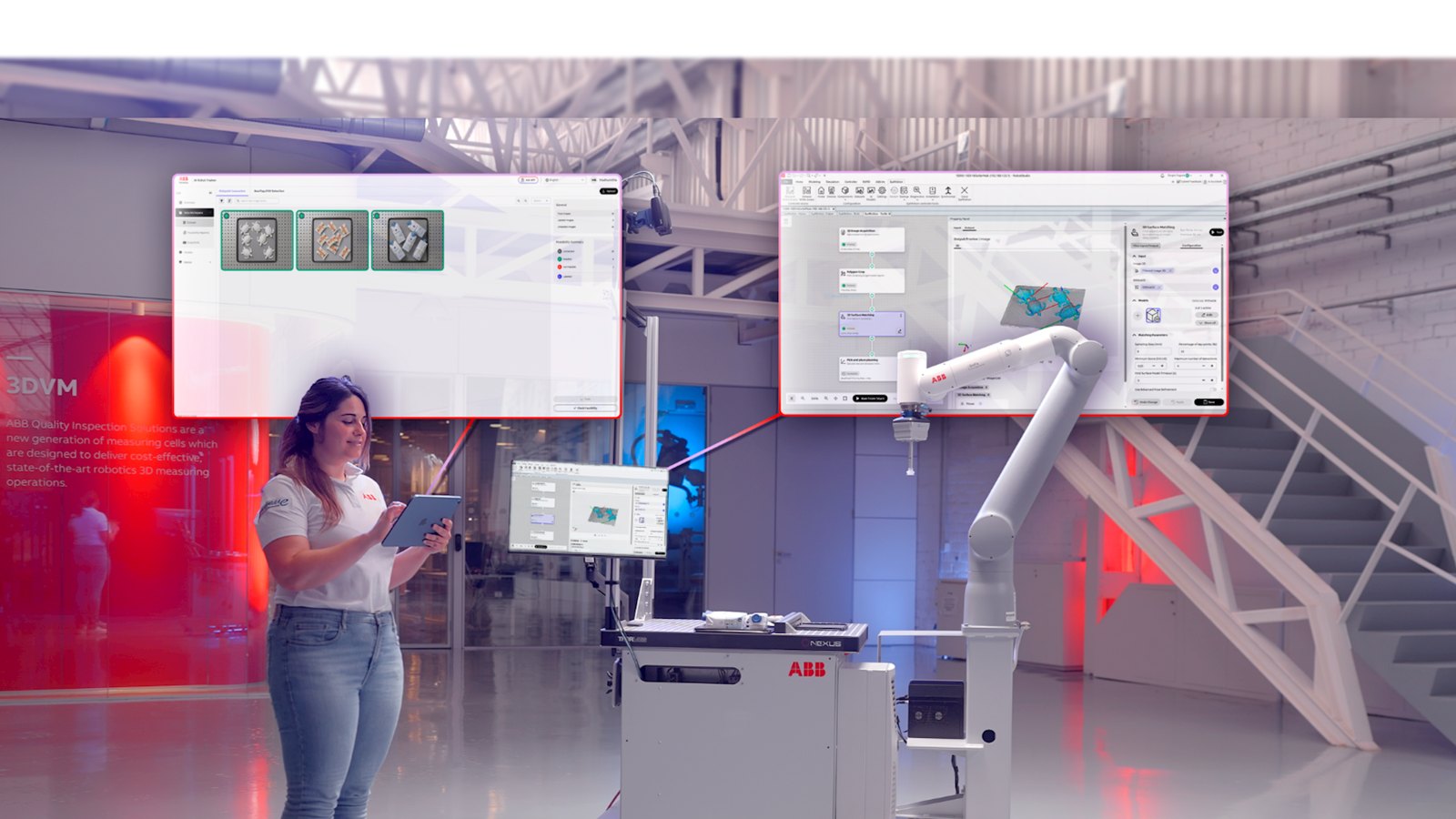
ABB Robotics said it is adding a tool called AI Robot Trainer to OmniCore EyeMotion, the vision system on its robot controller. The job of the tool, in the company’s words, is to let a customer train, deploy and keep improving a vision application without hiring someone to build a model from scratch. Image capture, training, deployment and later improvement sit in one workflow. What the camera sees is turned into a motion, using automatic planning that is meant to avoid collisions. ABB says the combination cuts commissioning time by up to 90 per cent and cycle time by up to 50 per cent. Both figures are the company’s, and the release does not show the lines they were measured against or name a customer whose clock moved.
The uses it lists are the ordinary ones: two-dimensional pick and place, three-dimensional bin picking, inspection, sorting and assembly. It says the workflow is meant to cope with a change of part, light, layout or object, and that it will take cameras and sensors from any manufacturer, mixing synthetic images with pictures from the floor. The system was on show at the China International Industry Fair in Shanghai, 12 to 16 October. A fair booth is a place to watch a picture become a movement. It is not a published miss rate from a factory that has run the tool for a month.
Where the calculation happens is not in the release
A claim circulating with the announcement says the vision now runs on the arm itself, with sub-millisecond reactions and no cloud at all, and names Keyence as the partner. None of that is in ABB’s release. The company does not say where the model runs, does not give a latency in milliseconds, and does not mention Keyence. A camera from any maker is not the same sentence as a named integration. Local inference would matter, if it were true, because a sorting line cannot wait on a data centre. Until ABB says the weights are on the controller, and a customer times the loop, “no cloud” is a guess.
What the release does establish is narrower and more useful. Setting up a vision job has been a specialist task, and ABB is selling a guided way through it, with a chatbot in the workflow, aimed at integrators who have to repeat the job across sites. If the 90 per cent holds on a real change of part, that is a cost of deployment, not a faster robot. The 50 per cent is a cycle time, and it is the number a plant would actually feel. Neither number is usable until someone other than ABB reports it.