Robotics · 29 October 2026 · 5 min read
AGIBOT wants robots scored in “Worken.” The numbers are on a slide
At Innovation Day in Shanghai on 29 October the company proposed a score of active robots times autonomous hours times an efficiency ratio. Its own stage graphic puts 14,400 on Guangzhou Metro guidance and 2,956.8 on a Longcheer line. The written release does not include the logs.
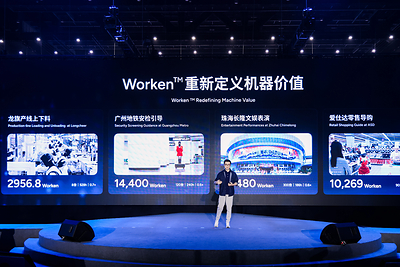
AGIBOT said on 29 October that the useful question about a robot is no longer how many were built. At Innovation Day in Shanghai, co-founder Peng Zhihui proposed a unit he calls Worken, from “work” and “token,” for productive work done in the real world. The formula in the release is simple: the number of robots actually on a task, times the hours they worked without a person driving them, times an “output efficiency ratio.” That ratio is supposed to compare acceptable output with a reference, such as a person doing the job to a set standard. The release says the benchmarks will be refined with operating data. A formula with a ratio that is still being refined is a proposal. It is not yet a standard another company can be held to.
The evidence AGIBOT chose to put on stage is a graphic, and the graphic is more specific than the prose. It labels 2,956.8 Worken for loading and unloading on a production line at Longcheer, 14,400 for security-screening guidance at Guangzhou Metro, and 10,269 for a retail shopping guide at ASD. A fourth panel, entertainment at Zhuhai Chimelong, is partly hidden by the speaker. The written release names Longcheer, the metro and Chimelong. It says the Longcheer robots are judged on cycle time, on staying at the job, and on finishing the task. It does not print the 14,400, the 2,956.8, or the dates those hours cover. A number on a slide can be true and still be unauditable from the document that travelled with it.
The rest of the day was a product list. G2 Max, which the company launched for manufacturing and logistics, is specified as 21 degrees of freedom, a dual-arm load of up to 40 kilograms, and a working height from 0.1 to 2.5 metres. Those are capabilities of a machine. They are not a count of machines sold, or of hours any one of them has already worked. AHA3 is described as a hardware platform that puts locomotion, interaction and task execution on one architecture, with new hands and grippers. GO-3 Preview is the next embodied model, and WITA-Omni 1.0 is an interaction model the company says ranks first on tests including Daily-Omni, RoboDojo, RoboTwin and RoboColiseum. First place on a test the maker reports is the maker’s result. It has not been rerun here.
The piece that could be checked later is the software, and it is not open yet. Link-U OS 1.0 is being tried by selected partners. AGIBOT says it has given the project to the OpenAtom Foundation and plans to open the code fully by the end of 2026. A plan for December is not a repository a reader can clone today. The useful shift, if Worken holds, is that a buyer would ask for hours and a ratio instead of a shipment. Until the worksheets behind the slide are published, and a customer confirms one of the panels, the score is the company’s.