AI · 19 November 2026 · 5 min read
NVIDIA Unveils Two-Prompt Cosmos Data Factory Blueprints for Automated Physical AI Training Data
Five agent-orchestrated workflows automate rare-event video synthesis and defect labeling, though NVIDIA’s headline 45x savings benchmark omits storage, agent fees, and human verification.
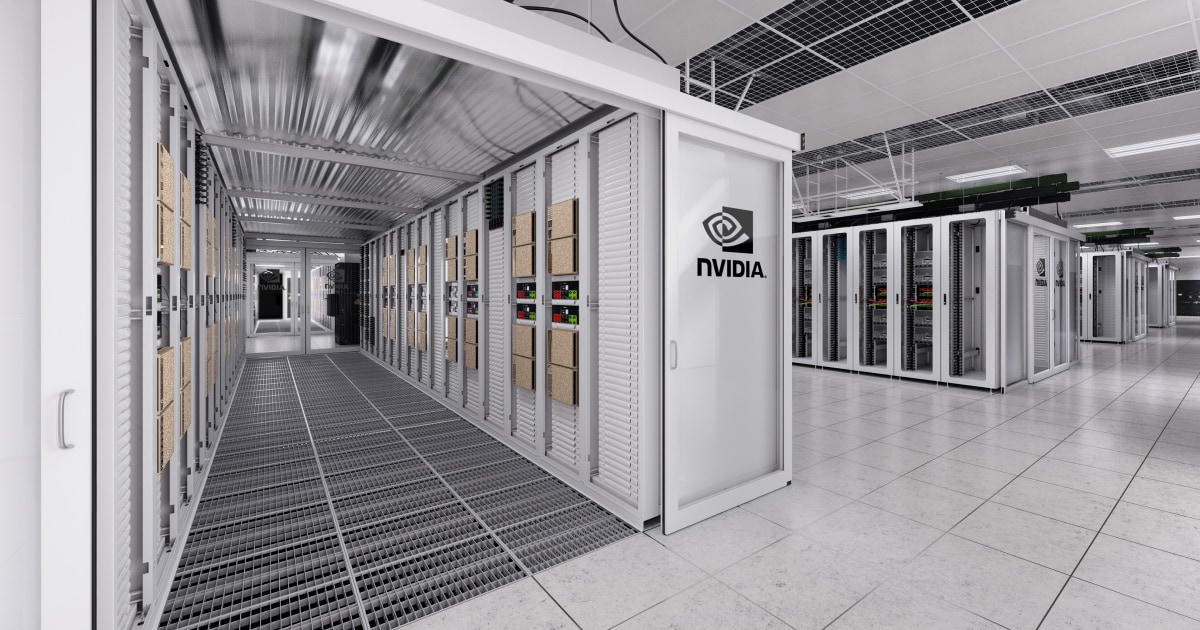
NVIDIA released a technical blueprint on November 18, 2026, demonstrating how engineering teams can deploy frontier coding agents and two text prompts to automate five synthetic data pipelines inside its Cosmos Data Factory platform (NVIDIA Technical Blog, Nov. 18, 2026). The workflows target autonomous vehicles (AVs), industrial robotics, and vision-based inspection systems.
By automating rare-event video generation and labeling, NVIDIA is tackling Physical AI’s hardest operational bottleneck: collecting statistically rare failure modes without maintaining sprawling human-driven test fleets.
Technical & Financial Breakdown
The two-prompt architecture splits setup from production. The first prompt directs a coding agent to run preflight checks and clone the Cosmos Data Factory orchestration stack onto Kubernetes with object storage and a container registry; the second triggers one of five workflows, spanning AV driving-scenario generation, lighting/environment augmentation, person re-identification, and circuit-board defect synthesis (NVIDIA Technical Blog, Nov. 18, 2026).
Generated footage passes through Cosmos Evaluator to filter out physically implausible outputs before automated detection, tracking, and captioning modules emit training-ready manifests. Running on an eight-GPU NVIDIA RTX PRO 6000 Blackwell Series cloud node estimated at $40 per hour ($960 per day), the pipeline generated roughly 130 AV edge-case clips per day (TokenPost, Nov. 19, 2026).
Benchmarking that compute rate against $125 per road-collected scenario, NVIDIA claimed up to a 45x cost reduction for AV scenario synthesis and a 60x speedup in defect-dataset assembly—shrinking a two-month workflow to a single day. NVIDIA also projected up to 90% fewer repeated physical test drives and 85% shorter regression cycles, citing ecosystem work with Porsche (via Voxel51) and ANYbotics (via Encord).
Second-Order Implications
Automated world-model data loops lower capital barriers for smaller robotics and AV teams training vision-language-action (VLA) models, allowing them to iterate on edge cases without massive field-collection payrolls. For NVIDIA, the commercial flywheel is straightforward: replacing physical road miles with synthetic video directly shifts automotive and industrial operational expenditure (OpEx) into continuous GPU compute demand.
Caveats & Open Questions
Engineering teams should read the benchmark footnotes closely. NVIDIA’s 45x cost reduction measures raw GPU rental only, excluding source-data curation, Kubernetes operations, object storage, coding-agent token costs, and human validation. Moreover, treating one synthetic video clip as fully equivalent to one real-world driving scenario glosses over persistent sim-to-real transfer gaps where subtle physics artifacts can degrade model performance on live roads.
More in AI