AI · 13 October 2026 · 6 min read
Google says Gemini 4 Argon taught a humanoid cornhole from a video
The model is on sale today. The robot result is an internal test: Apptronik’s Apollo made seven shots in a row after Argon wrote the simulation. Google has not published a miss, a second site, or a factory job.
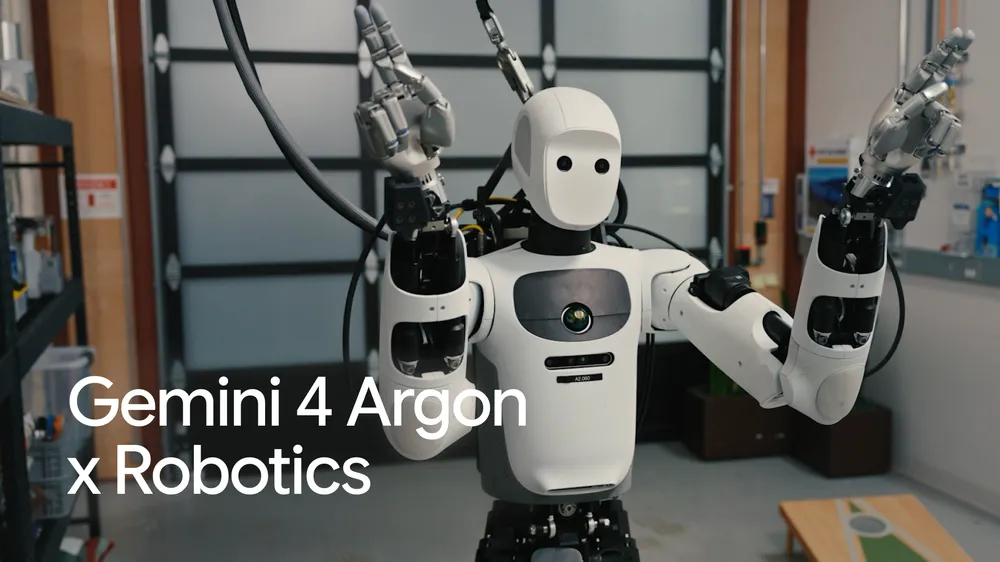
Google opened Gemini 4 Argon to paying users on 13 October and, in the same post, described a robot that learned a game by watching a person play it. In an internal test, Argon watched a raw video of cornhole, mapped the space, worked out the joint movements, and wrote the simulation code itself. Put on Apptronik’s Apollo humanoid, Google says the robot then sank seven shots in a row. The company calls the path video, then simulation, then the real machine, and says it compresses weeks of modelling into a few hours.
Seven in a row is a result. It is not a study. Google does not say how many attempts came before the streak, how far the board was, whether the bags were the same, or whether anyone outside Google timed it. A model that can write a simulator from a video is a different claim from a robot that can do the job again tomorrow in a room it has not seen. The post treats the first as the product and the second as a demonstration.
A score on paper, and a few chosen machines
On the Embodied Reasoning benchmark, which asks a model to solve physical and spatial problems from images rather than from a body, Google says Argon scores 87 percent on reasoning alone and beats the other frontier models it charts. Its developers-blog chart, labelled tool-off and N=400, puts Claude Opus 5.5 at 82.3 percent, GPT-6 Astra at 81.0, and Claude Fable 5.1 at 74.0. That is a test of looking at a scene and answering. It is not a test of gripping, balance, or a shift on a factory floor.
The longer developers post shows Argon on more than one machine, still as demonstrations Google chose. It describes a Boston Dynamics Spot, with a six-joint arm, practising a pedal bin in a MuJoCo twin and then stepping on the real pedal to drop cans. It describes a tabletop arm whose success on a pick-and-place task rose from 56 percent to 75 percent, and whose time fell from 35 seconds to 24, after Argon built a simulation from one photo and generated more than 4,500 practice episodes. Those numbers are Google’s. They are not an order, a customer, or a line that has to run when the light changes.
Who can use the model is narrower than the headline. Google says Argon is available today on the paid Gemini API, at an introductory price of $2 per million input tokens and $10 per million output tokens, and in the Gemini app and AI Mode for Google AI Ultra and Pro subscribers. Developers on the free tier do not get it from this announcement. A robotics team can buy the model. It cannot, from this post, buy the Apollo result.