Robotics · 12 October 2026 · 6 min read
JAKA is showing a heavy wheeled humanoid and a heavy cobot in Shanghai
The company told Shanghai Securities News the two machines debut on 12 October at the China International Industry Fair. The numbers it is willing to give are for an older, lighter model already in factories.
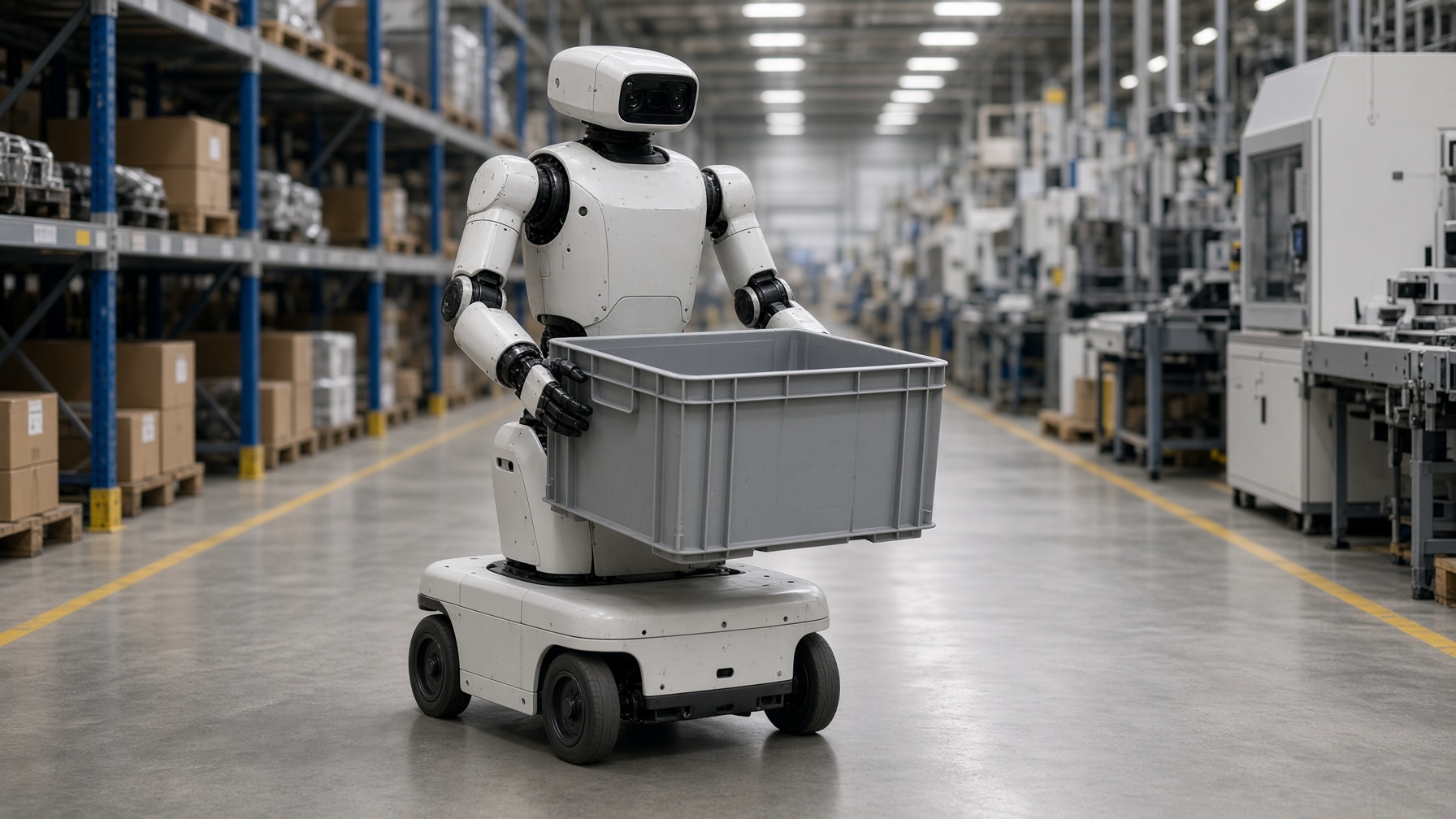
JAKA told Shanghai Securities News, in a report published on 11 October, that it would globally debut two machines on 12 October at the 26th China International Industry Fair in Shanghai. One is the JAKA Kargo50, a heavy-load wheeled humanoid aimed at moving totes. The other is the JAKA Zu50, a heavy-payload collaborative arm. The company said the pair fills gaps it already has a lighter answer for: Kargo50 sits in an existing wheeled-humanoid series, and Zu50 completes a cobot range that ran from light loads through medium ones.
The report does not give the Kargo50’s payload in kilograms, its price, or a customer. “Heavy” is the company’s adjective. The model name is not a specification this desk will treat as a weighed figure. What JAKA did quantify is the previous machine. It said the Kargo10 is already in volume use at auto-parts and electronics factories. After time on those lines, the company says, the work of one tote fell from 105 seconds to 28 seconds, and a new site can be stood up in 57 days. Those are the seller’s before-and-after numbers. They are also the only operating figures attached to this launch, and they belong to the lighter robot.
A fair is not a shift
JAKA said it would bring real factory jobs into the hall rather than a single repeated gesture. That is a better demonstration than a wave. It is still a demonstration. A cycle time of 28 seconds on a Kargo10 that has lived on a line is evidence about that line. A debut of a heavier sibling, on the first day of a fair, is a product on a stand. The distance between the two is the whole argument of the last few weeks of this file: manufacturing only counts once the machine is repeated, and a repeated machine is the one that already has a stopwatch on it.
The company also cited a 2024 industry figure: a 21.9 percent share of China’s collaborative-robot market, which it says was first place. That is a year old, and it is about arms, not about wheeled humanoids. It explains why a cobot maker wants a heavy arm. It does not say the Kargo50 has a share of anything.
Wheeled humanoids are the unfashionable version of the category, and they are the version a factory can use first. The robot does not have to walk. It has to roll to a rack, lift a box, and come back. If Kargo50 does that at a load the Kargo10 cannot, it is a bigger tool in a series that already has a stopwatch. If it only does it in Shanghai this week, it is a heavier prototype.