Robotics · 30 October 2026 · 4 min read
Opentrons raised $40 million. It did not say what the company is now worth
The Series E, announced on 29 October and led by Avego, is for lab robots, the software that writes protocols, and what the company calls autonomous science. Opentrons says more than 11,000 robots are out. There is no valuation, and no count of experiments a customer has finished.
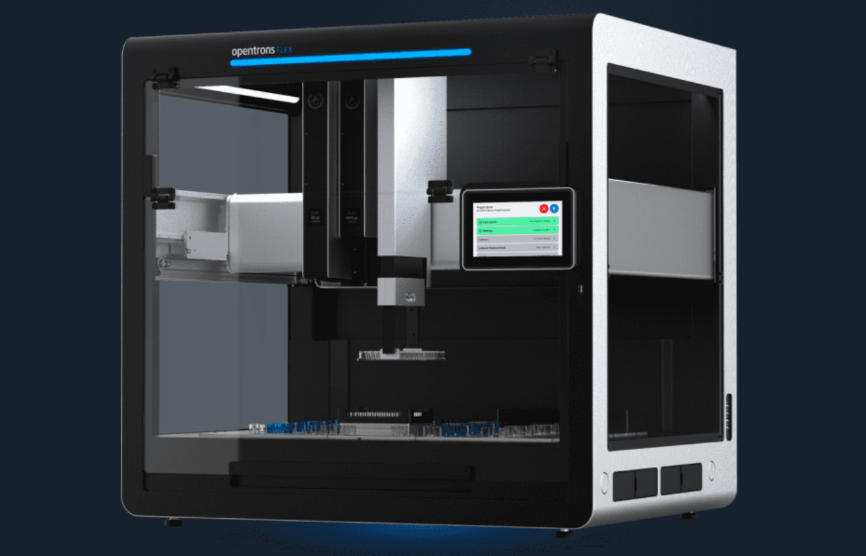
Opentrons Labworks said on 29 October that it has raised a $40 million Series E. Avego led the round. BroadOak Capital Partners also invested. The company says existing investors include SoftBank Vision Fund and Khosla Ventures, which is a list of who is already on the cap table, not a statement that they wrote a cheque in this round. The release gives no valuation. A round without a valuation is still a round. It does not say what a share was worth on the day before.
The installed base is the number Opentrons wants read next to the money, and it is the company’s number. More than 11,000 robots, it says, are in laboratories in more than 80 countries, including 90 percent of the top 20 global pharmaceutical companies, every top-20 research university in the United States, and 14 of the top 15 global biopharma companies. Those are coverage claims. They are not a lab-by-lab list, and they are not a count of how often each machine is switched on. A robot in a university can be a workhorse or a purchase that sits.
What the money is for is written as a direction, not a budget. The release says the round funds the next phase of what Opentrons calls autonomous science: AI and robots that design an experiment, run it and learn from it. The company says it will spend on experimental execution, on more automation, and on new markets, and that the software should make protocols faster to write. James Atwood, the chief executive, said millions of scientists spend the day on work a robot can do, and that autonomous science is standardising on Opentrons. James Flexner, managing partner at Avego, said every AI-driven discovery still has to be tested in a real lab. Both sentences are the case for the investment. Neither is a measurement of time saved.
The line under the headline is the one to keep separate from the $40 million. “Every experiment run on Opentrons laboratory automation robots generates structured, reproducible data” is the company’s description of its own machines. Structured is a design goal. Reproducible is a result, and the release does not show a result: no error rate, no share of runs a scientist accepted, no customer confirming that an outside model closed the loop. The Flex is the platform named. Until a named lab publishes what the robot did that a person had been doing, the round is capital for a benchtop fleet. It is not evidence that the experiments now run themselves.