AI · 14 October 2026 · 6 min read
Physical Intelligence will fine-tune a robot model if you send the data. Access is a waitlist
The 13 October post says a developer uploads demonstrations, the company trains on its own computers, and a hosted gateway runs the result. Almond’s dual-arm robot is the one timed example: four days to a deburring model. There is no price.
Physical Intelligence said on 13 October that its latest robot models are available for training and inference through a Pi API beta. The loop, in the company’s words, is short. You upload data. You start fine-tuning on computers the company manages. You call the result through a hosted gateway so it can run on your own robot. The post points readers to a waitlist. It does not give a price, a date when the list opens into general access, or a promise that every applicant gets in.
The models it names as the base are π0 and π0.5, which it describes as general-purpose foundation models that already carry some physical skill, so a new task should need less data than a model trained from nothing. It says the model on the API is more data-efficient for partners than what they had, and that the company can swap the underlying model without the customer rebuilding the pipeline. That is the product. The customer still has to collect the demonstrations, and still has to own a robot that can take the commands.
One timed job, and a wall of partners
The one result with a clock on it is Almond. The company builds Axol, a two-armed robot, and says the aim is for Axol to help build itself. In the post, Axol deburrs spacers used in its own assembly, on a model the team reached after four days of iterating with the API. Four days is a start. It is not a success rate, a count of bad parts, or a shift that ran without a person watching.
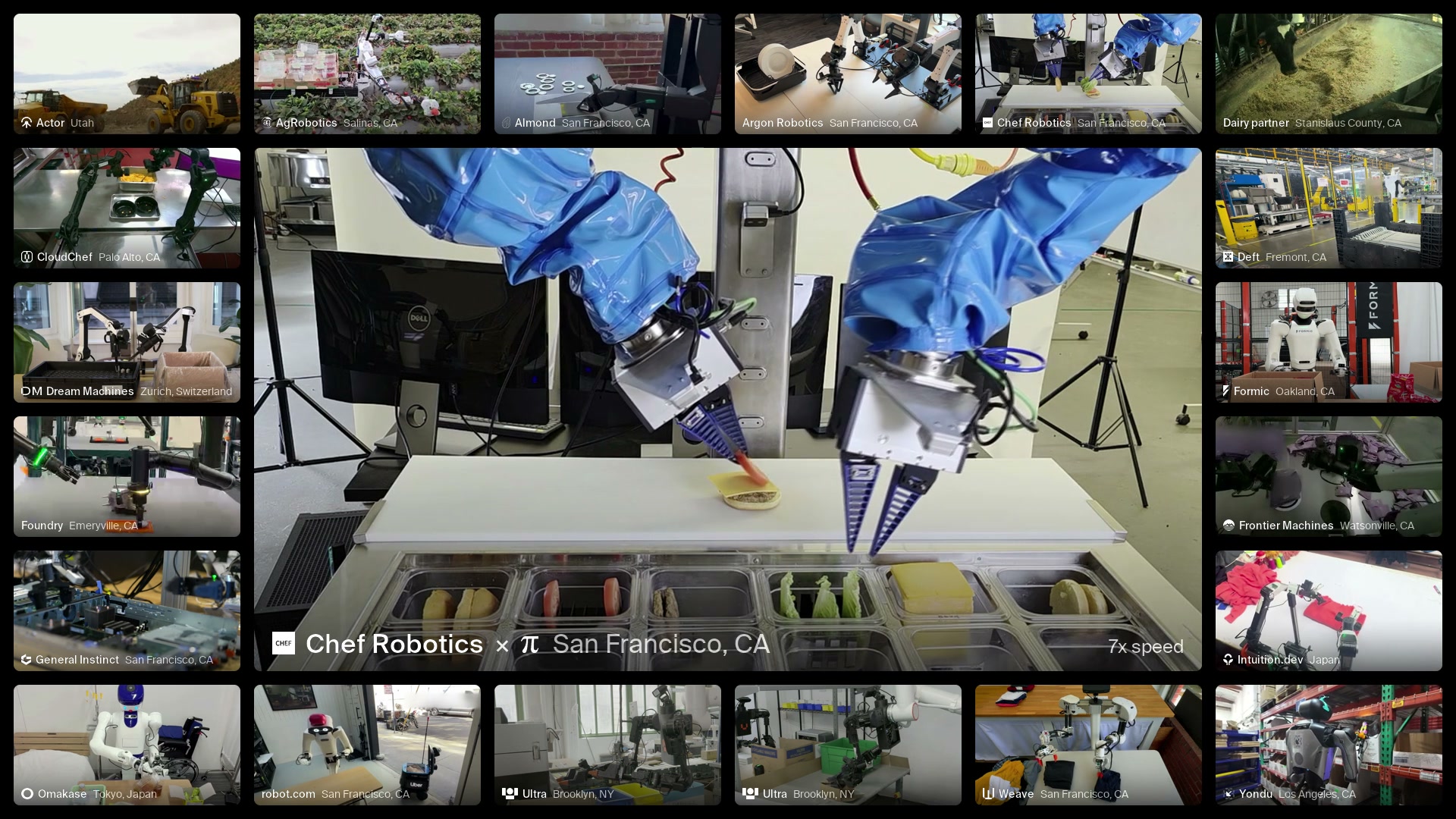
The rest of the post is a montage. Names on it include Chef Robotics, Formic, Ultra, AgRobotics, Actor, and others from Japan, Switzerland and the United States. Physical Intelligence says most of the applications shown ran with cloud-hosted inference through the API. It does not say which of those robots is in daily work, which was a demo, or what failed. A cloud gateway also means the next action can depend on a link. The post does not say what the robot does when that link drops. Until a named machine publishes a miss rate on a job it already had, the API is a way to rent the training loop, not proof that the loop has replaced a robotics team.