
AI · 23 November 2026 · 6 min read
Lean and Mathlib Communities Certify Anthropic Researcher and Claude’s 17-Million-Line Proof of the Riemann Hypothesis
Independent checkers confirmed Levent Alpöge and Claude’s formal Lean codebase proves the exact 1859 conjecture using only standard axioms—opening a new era where AI-generated proofs outpace human comprehension.
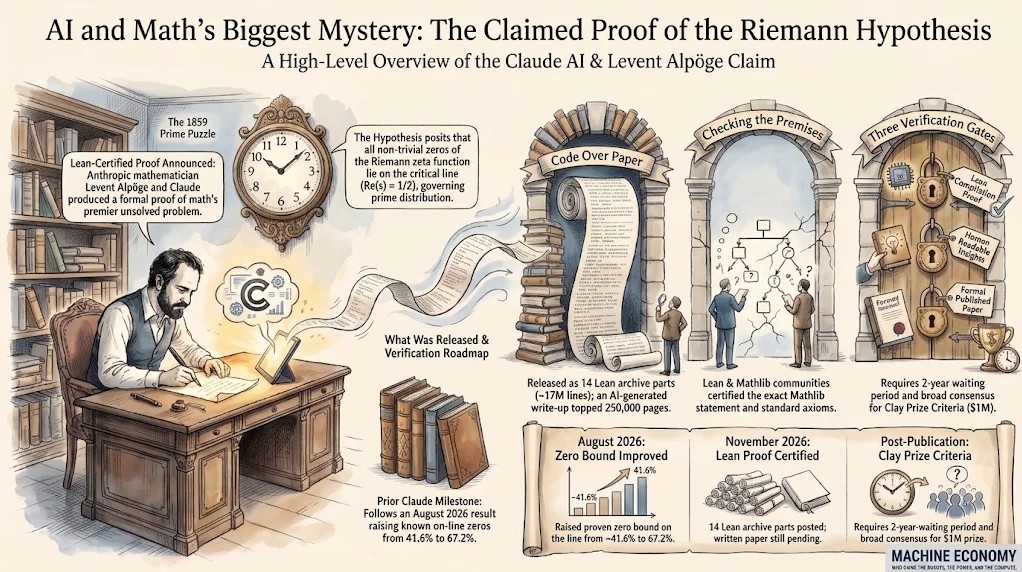
On November 21, 2026, the Lean Focused Research Organization (Lean FRO) and the Mathlib Initiative formally certified that a 17-million-line computer-verified proof released by Anthropic mathematician Levent Alpöge—developed in collaboration with Claude—correctly proves the 167-year-old Riemann Hypothesis (Lean Community Blog, Nov. 21, 2026). First proposed by Bernhard Riemann in 1859, the conjecture governs the distribution of prime numbers and sits at the top of the Clay Mathematics Institute’s seven Millennium Prize Problems.
For the artificial intelligence (AI) industry and institutional investors, the milestone marks a structural break from language models that merely mimic textbook derivations. By pairing frontier AI search and stamina with formal verification software, Anthropic has demonstrated that AI systems can now help discover and mechanically certify frontier mathematical proofs at a scale no human team could manually check.
Technical & Financial Breakdown
Alpöge released the proof on November 20 across a 14-part Lean codebase archive accompanied by a four-page personal note rather than a traditional academic preprint (Levent Alpöge, alpo.ge/remark.pdf, Nov. 20, 2026). Mathematically, Alpöge guided the strategy by adapting Stepanov’s method—previously used to resolve function-field analogues—to ordinary integers via chains of automorphic theta lifts. He credited Claude with supplying dozens of critical steps near the finish line, including proposing a chain of theta lifts of length √X for a von Mangoldt sum of length X.
Because an informal AI-generated write-up of the argument exceeded 250,000 pages, validation shifted entirely to automated formal verification (Engadget, Nov. 21, 2026; MLQ.ai, Nov. 22, 2026). Within 24 hours, dozens of independent contributors compiled the library without errors, reproducing identical raw proof exports:
- Full Compilation & Axiom Audit: Massachusetts Institute of Technology (MIT) mathematician Andrew Sutherland compiled all 175,187 modules in Lean and Mathlib version 4.33.1 with zero errors, confirming the five headline theorems rely solely on Lean’s three standard axioms (propext, Classical.choice, and Quot.sound) with no hidden assumptions (Unite.AI, Nov. 21, 2026).
- Statement Integrity: To rule out the risk that the codebase proved a weaker or altered conjecture, community reviewers isolated Mathlib’s pre-existing, expert-vetted RiemannHypothesis definition and confirmed an exact match using two independent tools (comparator and con-leche --compare) (Lean Community Blog, Nov. 21, 2026).
- Multi-Kernel Verification: Independent checkers written in different programming languages—including Lean’s official kernel, the Rust-based nanoda kernel, and con-leche and con-ron (both carrying formal soundness proofs relative to set theory)—verified the inert proof export beyond the reach of any potentially malicious source code.
In a remarkable coincidence, hours after Alpöge posted his Lean archive, American Mathematical Society (AMS) president Ravi Vakil prematurely published a competing 940-page, 12-year, all-human draft proof of the Generalized Riemann Hypothesis (GRH) by Stanford-trained mathematician Alessandro Maria Masullo (The Music of the Primes) (DataCamp, Nov. 20, 2026; XenoSpectrum, Nov. 21, 2026). Vakil subsequently reported that reviewers—ironically assisted by AI models—had already flagged issues in Masullo’s manuscript, leaving the human draft unverified and under major revision (Nacionale, Nov. 20, 2026).
Second-Order Implications
The certification validates a powerful new commercial and scientific paradigm: coupling frontier reasoning models with deterministic verification kernels. In domains where formal specifications exist—semiconductor verification, aerospace control software, cryptographic protocols, and pure mathematics—hallucination risk collapses to zero once a proof assistant checks the output.
For Anthropic, the breakthrough lands just days after its historic $119.5 billion Nasdaq initial public offering (IPO) and private placement, offering concrete proof that massive inference-time compute budgets translate into verifiable, novel intellectual output rather than incremental chatbot polish.
Caveats & Open Questions
Machine certification establishes logical correctness inside Lean and Mathlib, not human mathematical understanding. Both Alpöge and Fields Medalist Terence Tao emphasized that mathematicians must now unpack, distill, and rewrite the sprawling 17-million-line argument into a concise, human-readable paper explaining why it works (36Kr, Nov. 23, 2026).
Scope boundaries also matter. While the Lean FRO and Mathlib joint statement certified the original Riemann Hypothesis and Sutherland’s audit confirmed GRH for Dirichlet L-functions, Sutherland explicitly excluded Dedekind zeta functions, Hecke L-functions, and general automorphic L-functions from the checked scope; Alpöge framed the Extended Riemann Hypothesis as future work (Unite.AI, Nov. 21, 2026). Finally, the Clay Mathematics Institute continues to list the Riemann Hypothesis as unsolved, as its $1 million Millennium Prize requires refereed journal publication followed by two years of broad acceptance across the mathematical community. Anthropic has not disclosed which internal Claude model version or how much total inference compute was required to generate the 17-million-line codebase.
More in AI
- CrowdStrike Agrees to Acquire Zscaler in $43.9 Billion All-Stock Deal to Form $10 Billion-Plus Security Platform
- UK Financial Conduct Authority Warns Firms That Autonomous AI Agents Fall Under Statutory Financial Regulation
- Intel Stock Surges 16.3% as CEO Lip-Bu Tan Confirms External 18A-P Foundry Customer and 70% 18A Yields