AI · 11 October 2026 · 6 min read
Meta’s robotics lab releases an 8-billion-parameter world model
RoboJEPA, posted on 7 October, was trained across 12 kinds of robot. The authors say its planning gets better as the model gets larger, and that a copy can be aimed at a goal image on real hardware. The numbers are theirs.
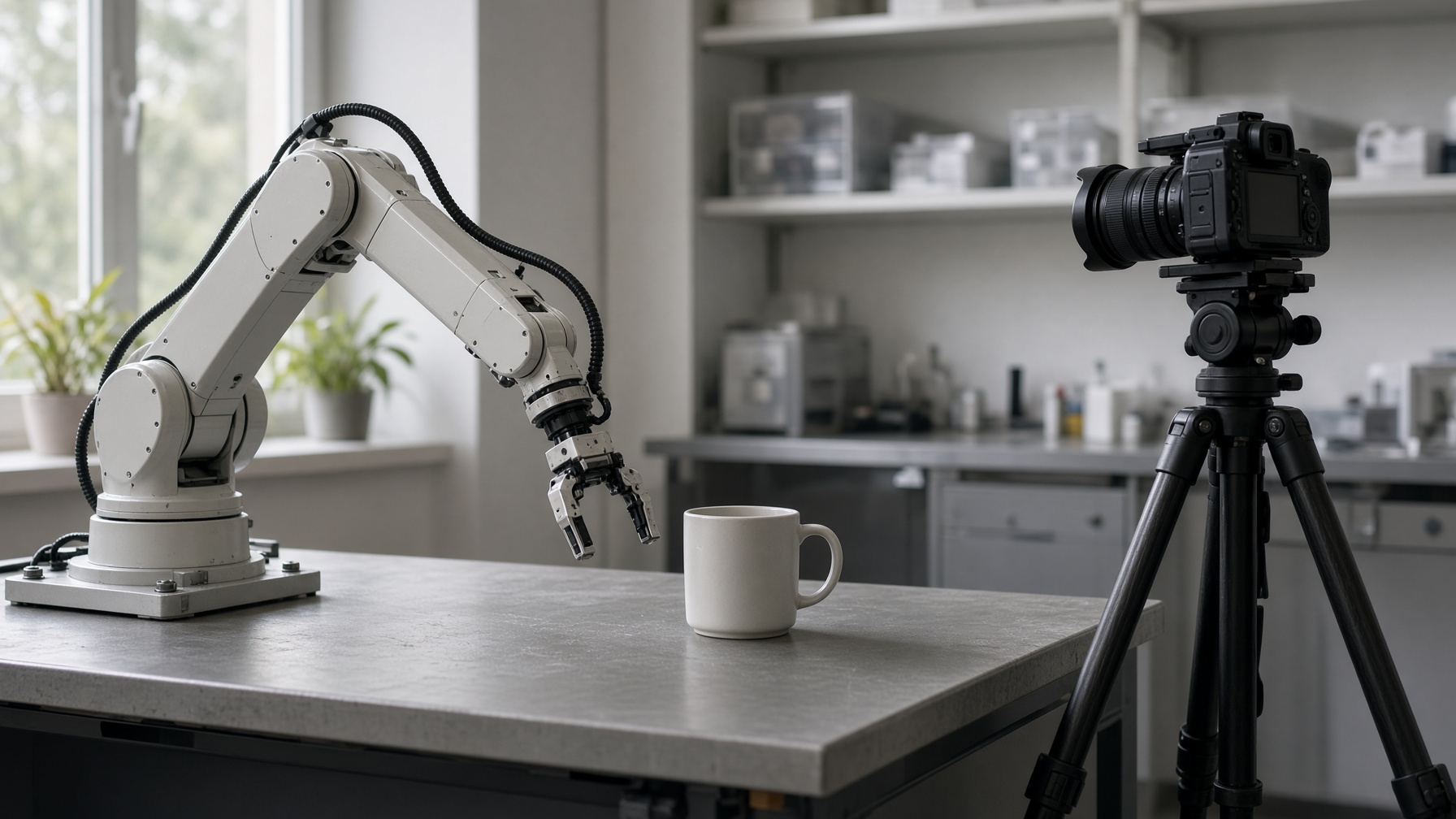
Researchers at Meta’s FAIR lab have released RoboJEPA, a world model for robots, in a paper submitted on 7 October. A world model, in this use, is a system that tries to predict what happens next so a robot can plan, rather than a system that only labels the frame it is looking at. RoboJEPA is built on the Joint Embedding Predictive Architecture. The largest version has 8 billion parameters. The authors say that is the largest JEPA predictor trained so far, and that the work is the first set of scaling laws for a world model trained on real robot data across more than one kind of body.
The dataset spans 12 robotic embodiments. The paper does not, in its abstract, say how many hours that is, or how many of those hours were useful. What it does claim is a pattern: the error in the model’s imagined futures follows a second-order power law in the amount of compute used to train it. In plainer words, they fitted a curve to smaller models and say it still described the larger ones. They also say that planning on real tasks improves in a predictable way as compute rises, and that the imagination error tracks that planning performance closely enough to stand in for some tests on a physical robot.
A goal image is not a job description
The last claim is the one a factory would care about. The authors say a latent world model can be put on real hardware with no extra training for that robot, and can plan toward a single goal image on tasks that take a long sequence of moves. Checkpoints, training code and deployment code are released. A goal image is a picture of the scene the robot is supposed to end on. It is a clean experimental target. It is not a shift in a warehouse, where the goal changes, the lighting changes, and nobody hands the robot a photograph of the finished pallet.
Zero-shot, here, means the authors say the same model worked on hardware it was not specially trained to control. It does not mean a third party has repeated the result, and it does not mean the model is for sale. An 8-billion-parameter predictor is also not something a small arm will run on its own battery without a larger computer nearby. The paper is about whether prediction error falls as the model grows. It is not a product announcement.
The useful comparison is with the models that only imitate a demonstration. Those copy a motion they have been shown. A world model is trying to say what the scene will look like after the motion, and then choose the motion that gets closer to the goal. If the scaling claim holds, more compute buys a more accurate imagined future, and that accuracy shows up as better plans. If it does not hold outside the authors’ own robots, the curve is a result about their dataset, not a law of robotics.