Robotics · 4 November 2026 · 5 min read
Xiaomi says a humanoid worked an eight-hour factory task. The clip is sped up, and the parts are not counted
On 3 November Xiaomi posted two full-size humanoids sorting centre-console side covers at its car factory. The company says the task ran for eight hours, that the robots corrected their own faults, and that the station met a full day’s production. The video is labelled autonomous and is played at 5× and 100×. There is no parts-per-hour figure, and no intervention rate.
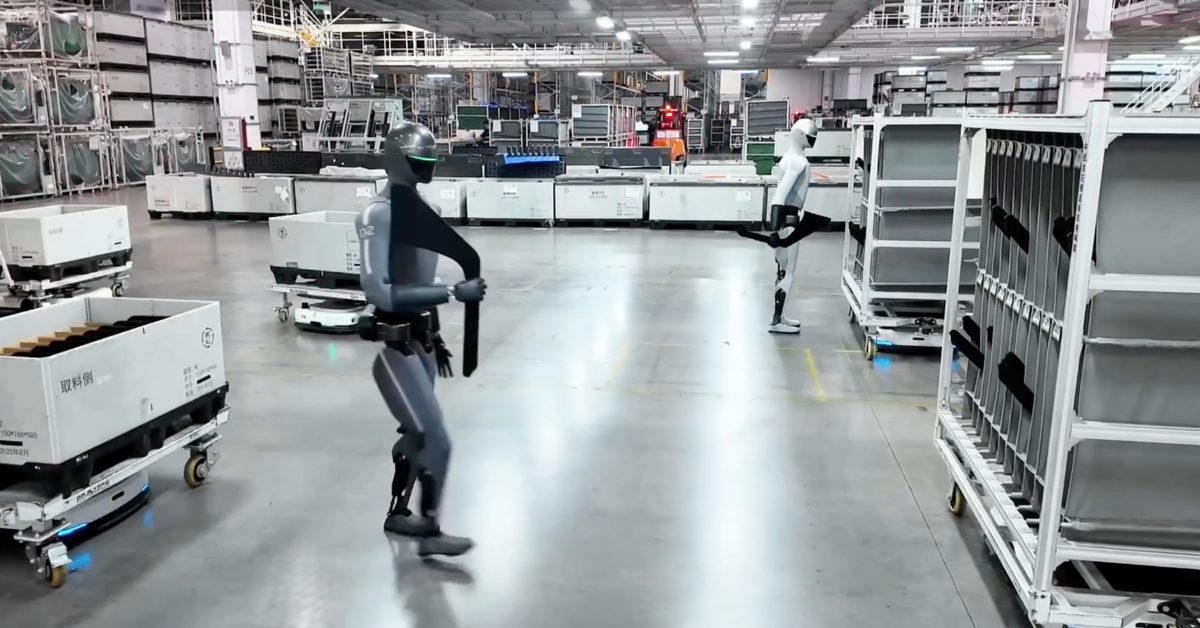
The post is the primary sentence. Xiaomi Tech wrote, on 3 November: “8 hours on the production line. Xiaomi’s full-size humanoid robot takes on an 8-hour task at the Center Console Side-Cover Sorting Workstation at Xiaomi Auto Factory.” The rest of the caption says the robot can autonomously detect and correct anomalies while coordinating with the line. Humanoids Daily, the same day, describes what is in the clip: two robots moving covers between bins on mobile platforms and slotted racks. A counter of cumulative working time runs on the picture. Overlays say “Autonomous”, and the playback includes 5× and 100×. A clock on a sped-up clip is not a timesheet.
Gasgoo, reporting the World Internet Conference opening in Wuzhen that day, puts the company’s claim in one line. The robot “tackled an eight-hour shift for the first time”, “met full-day production requirements”, and did so with autonomous error correction and system-level coordination. Gasgoo calls that an initial validation. Xiaomi does not say how many covers moved, how often a person stepped in, or which faults were corrected. Humanoids Daily is explicit on the battery: an eight-hour task must not be read as eight hours on one charge, because the post does not describe charging or a swap. The model name is not in the post, and it is not in that account. This desk will not supply one.
A different job, in a flat
The same Gasgoo note describes a separate trial. Xiaomi says an embodied model has begun a “pilot run” at Xiaomi Youth Apartments, on a pre-trained model it calls Xiaomi-Robotics-1. The company says the loop covers data, inference and execution, and that task chains run for more than 30 minutes across three rooms and more than 50 tasks. An apartment pilot is not the factory station. The factory station is not the apartment.
In March, on a different job, Xiaomi reported a 90.2 per cent success rate on dual-side self-tapping nuts over three hours, at a 76-second cycle, in its Beijing electric-vehicle factory. That percentage belongs to the nut trial. It is not a score for the sorting clip. The awards that day are also for Xiaomi to name. Gasgoo says the group received an Outstanding Contribution Award at the conference opening, and the robotics division a Leading Technology Award, for a general-purpose robot operation base model.
Gasgoo also reports the company’s research figures: 105.5 billion yuan from 2021 to 2025, and 33.1 billion yuan in 2025 alone, up 37.8 per cent on the year before. Xiaomi says it plans more than 200 billion yuan of research over five years, of which more than 60 billion yuan is for AI over three years, including large models, embodied intelligence and intelligent manufacturing. A five-year plan is not the cost of this shift.