AI · 27 October 2026 · 4 min read
Genie 4 can change a scene while it is playing. The robot in the demo is not on a floor
DeepMind’s new world model, announced on 27 October, generates sound with the picture and takes a typed instruction in the middle of a run. Gemini 3.8 Flash watches the frames. Access is a research preview, then Google AI Ultra and a few API partners. Google’s own note says objects still drift.
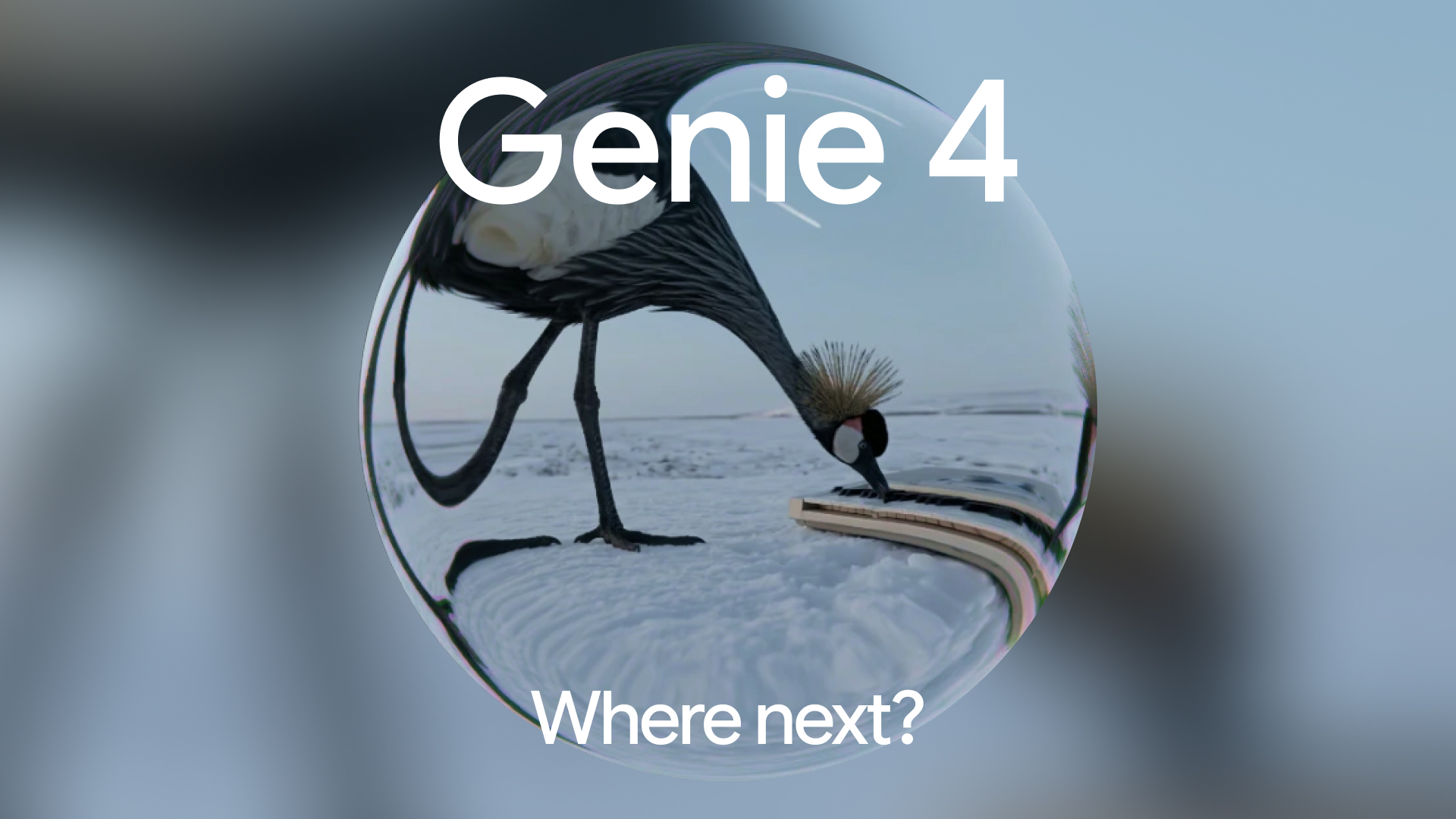
Google DeepMind announced Genie 4 on 27 October. It is a world model: from a prompt it generates a scene a person can move through, and the scene can be steered while it is running. A typed instruction can change the weather, move the camera, or put a new person or object in the frame. Gemini is supposed to fit that instruction to the place already on screen, and, between instructions, to keep the scene moving as one place. The part DeepMind says no earlier real-time Genie had is native audio. Wind, waves, music and dialogue are generated with the frames, and the dialogue is meant to change if the scene does. A soundtrack added afterwards is a different product.
The director inside the loop is named. Gemini Omni is described as the anchor for how things look and behave. Gemini 3.8 Flash watches the run, breaks a goal into steps, and checks each frame. Google has told reporters the coherent stretch is about two minutes, against about one minute for Genie 3. DeepMind’s own post is more cautious. It calls Genie 4 an early, experimental model. Over a longer run, after several edits, or as the view moves through the scene, visual detail and object permanence can still drift. Complex physics, accurate live audio, readable text and long-term consistency are listed as open research. A clip of a crane, or of a maple seed falling, is not a count of how often that drift happens.
The robotics claim needs the same separation. DeepMind shows Gemini 4 Argon and Genie 4 together, with Argon writing the steps and Genie drawing the scene. One of those scenes is Apptronik’s Apollo at a checkers board. The graphic itself is labelled “Genie 4 simulation.” It is not a photograph of Apollo in a building, and it is not the earlier internal test in which Google said a real Apollo sank seven cornhole shots. A simulated hand that opens above a counter is a place to try a plan. It does not move a tote, and it does not get tired.
Who can try it is a short list. Genie 4 is a research preview for trusted testers. DeepMind says it is coming soon to Google AI Ultra subscribers inside Project Genie, and to early-access partners on the Gemini API and in AI Studio. There is a waitlist. There is no public price for the API. A subscription that can open the demo is not, by itself, a robotics budget. A world a person can walk through for a couple of minutes is a research tool, and a creative one. The day it trains a robot is the day a log from a real machine is published next to the clip.